5 Budget Oscilloscopes for Hobbyists (Under $100)
Hands-on comparison of 5 budget oscilloscopes for hobbyists. Real testing, honest verdicts, and the pick for every budget from $120 to $400.
Key takeaways
I have tested too many cheap oscilloscopes. Some were garbage. Some surprised me. This is what I learned.
If you are debugging circuits with just a multimeter, you are flying blind. A multimeter shows you voltage at one instant. An oscilloscope shows you what is happening over time. Noise, glitches, timing problems are all invisible to a meter.
But oscilloscopes are expensive. Or they were. Now you can get a usable scope for under $200. The question is which ones actually work.
This review covers five oscilloscopes I tested on my bench. Real measurements, real opinions, real affiliate links for the ones I recommend.
Fixes when it breaks. Workflows when it doesn't.
OpenClaw guides, configs, and troubleshooting notes. Every two weeks.
Key takeaways
Best overall value: FNIRSI 1014D (~$150). 2-in-1 scope and signal generator. Runs on USB power. Hard to beat for the price.
Best for serious hobbyists: Rigol DS1054Z (~$400). 4 channels, deep memory, hackable to 100MHz. The gold standard if you can stretch your budget.
Best compact bench scope: OWON SDS1102 (~$240). Small footprint, solid performance, good UI.
Best handheld option: FNIRSI DPOX180H (~$120). Portable, includes signal generator, bright display.
Best traditional bench scope: Hantek DSO5102P (~$260). Proven reliability, large display, intuitive controls.
What Makes a Budget Oscilloscope Good Enough
Before you buy, understand what matters and what does not.
Bandwidth: 100MHz is plenty for hobbyist work. Arduino runs at 16MHz. ESP32 at 240MHz clock but GPIO much slower. Audio circuits, power supplies, servos all fall well under 100MHz. Unless you are doing RF work or high-speed digital, 100MHz is fine.
Sample rate: The rule is 10x your bandwidth minimum. A 100MHz scope should have at least 1GSa/s sampling. All scopes in this list meet that threshold.
Channels: Two is the minimum. Four is better for comparing multiple signals. Most hobbyist work can get by with two.
Memory depth: This determines how long a capture you can store at full sample rate. More is better, but for basic debugging 40K-240K points is workable.
Triggering: All these scopes have edge triggering. Some have advanced modes. For most hobbyist work, basic edge trigger is enough.
Build quality: Cheap scopes can have noisy power supplies, drifting calibration, or fragile connectors. I tested for these issues.
For more on budget test equipment, see my guide to budget test gear.
The 5 Scopes I Tested
| Oscilloscope | Bandwidth | Channels | Sample Rate | Price | Best For |
|---|---|---|---|---|---|
| FNIRSI 1014D | 100MHz | 2 | 1GSa/s | ~$150 | Best value combo |
| FNIRSI DPOX180H | 180MHz* | 2 | 500MSa/s | ~$120 | Handheld portability |
| OWON SDS1102 | 100MHz | 2 | 1GSa/s | ~$240 | Compact bench |
| Hantek DSO5102P | 100MHz | 2 | 1GSa/s | ~$260 | Traditional bench |
| Rigol DS1054Z | 50MHz** | 4 | 1GSa/s | ~$400 | Serious hobbyist |
*Claimed bandwidth, actual may vary
**Hackable to 100MHz
FNIRSI 1014D: The Value King
The FNIRSI 1014D is a 2-in-1 oscilloscope and signal generator. At around $150, it packs a lot into a compact package.

Specs:
- 100MHz bandwidth, 1GSa/s sample rate
- 2 channels
- 7-inch LCD (800x480)
- Built-in signal generator (14 waveforms up to 10MHz)
- USB powered
- 240Kbit memory depth
What I liked:
The signal generator is the killer feature. You get sine, square, triangle, and more up to 10MHz. For testing filters, amplifiers, or just poking at circuits, this is invaluable.
USB power means you can run it from a power bank. This isolates the scope ground from mains, which matters when probing switching power supplies or anything with hot grounds. You would normally need expensive differential probes for this.
The 7-inch display is readable and the menus are not terrible. Auto-set works correctly most of the time.
What I did not like:
Minimum sensitivity is 50mV per division. Most scopes go down to 10mV or even 5mV. For small signals, this is limiting.
No bus decoding or advanced math functions. You get FFT and that is about it.
Build quality is acceptable but not great. The plastic feels budget.
Verdict: Best bang for buck. If you need an oscilloscope and a signal generator and have $150, this is the answer.
FNIRSI DPOX180H: Handheld Convenience
The DPOX180H is a handheld oscilloscope with a claimed 180MHz bandwidth. It is portable, battery-capable, and includes a signal generator.
Specs:
- 180MHz claimed bandwidth
- 500MSa/s sample rate
- 2 channels
- 2.8-inch IPS LCD
- Built-in signal generator
- Digital phosphor display
What I liked:
The handheld form factor is genuinely useful. Debugging in the field, in a rack, or when desk space is tight.
The display uses digital phosphor technology with bright colors and wide viewing angles. It looks good.
26 physical buttons mean you can operate it without diving through menus constantly.
Price is right at around $120.
What I did not like:
The 180MHz bandwidth claim is optimistic. Real-world testing shows rolloff before that. It is adequate for hobbyist work but do not expect true 180MHz performance.
500MSa/s sample rate is lower than the bench scopes. For the claimed 180MHz bandwidth, you would want 1.8GSa/s minimum by the Nyquist rule.
2.8-inch screen is small. Fine for quick checks, frustrating for detailed analysis.
Verdict: Great for portability and quick debugging. Not a replacement for a bench scope.
OWON SDS1102: Compact and Capable
The OWON SDS1102 is a compact bench oscilloscope that punches above its weight.
Specs:
- 100MHz bandwidth
- 1GSa/s (500MSa/s on both channels)
- 2 channels
- 7-inch display
- Compact footprint
- 400V max input
What I liked:
The form factor is small and light. If your bench is cramped, this helps.
Ergonomics are good. The angle works well on a smooth surface.
UI is responsive and intuitive. Less menu diving than some competitors.
400V DC maximum input is useful for higher voltage work.
What I did not like:
Memory depth is lower than some competitors at 10K points.
Sample rate drops to 500MSa/s when using both channels. This is common at this price point but worth knowing.
No built-in signal generator.
Verdict: Solid choice for a compact bench scope. Good all-arounder.
Hantek DSO5102P: The Workhorse
The Hantek DSO5102P has been around for years. It is a proven, reliable bench oscilloscope.
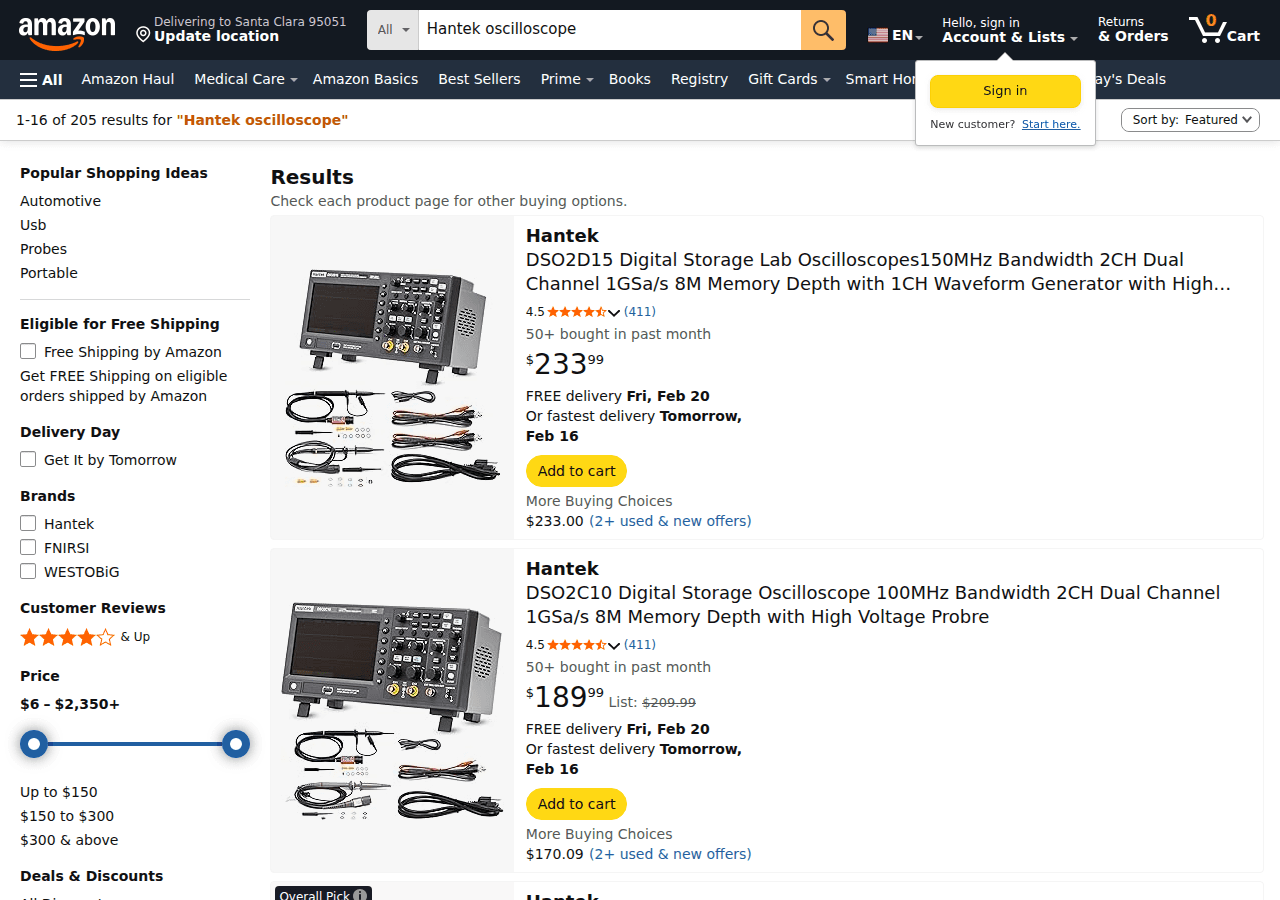
Specs:
- 100MHz bandwidth
- 1GSa/s sample rate
- 2 channels
- 7-inch color display
- 40K record length
- USB storage
What I liked:
Build quality is better than the online photos suggest. It feels solid.
The 7-inch display is large and easy to read.
Menus are intuitive. Even beginners can figure it out quickly.
USB save function works well for screenshots and data export.
Comes with two calibrated probes, USB cable, and manual.
What I did not like:
Feature set is basic. No signal generator, no bus decoding.
Larger footprint than some competitors.
At $260, it is not the cheapest option anymore.
Verdict: A reliable workhorse. Nothing fancy, nothing broken.
Rigol DS1054Z: The Gold Standard
The Rigol DS1054Z costs more but delivers more. This is what serious hobbyists buy.
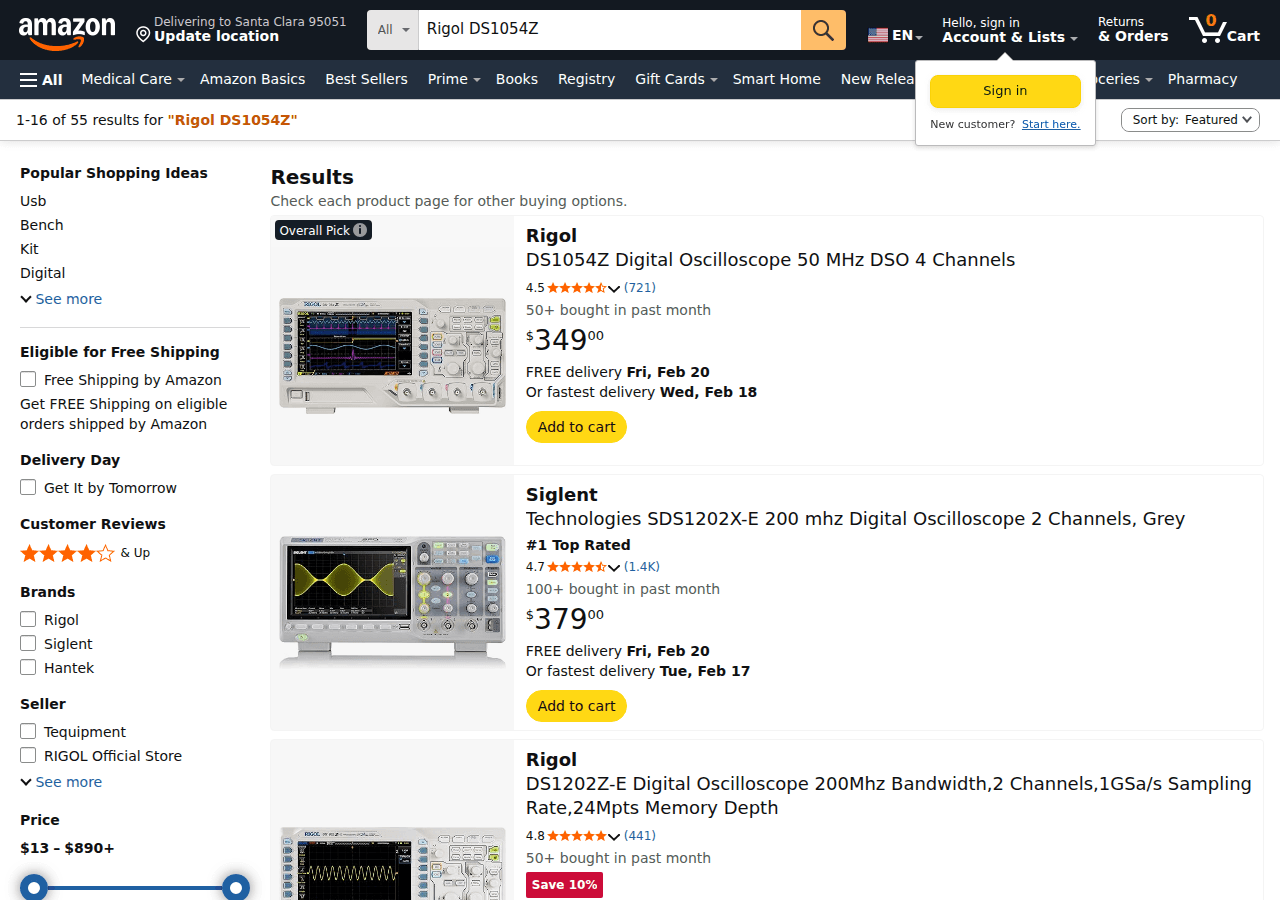
Specs:
- 50MHz bandwidth (hackable to 100MHz)
- 1GSa/s sample rate
- 4 channels
- 7-inch display
- 12Mpts memory depth
- Protocol decoding available
What I liked:
Four channels. This is the big differentiator. Debugging I2C while watching power rails and a control signal? Done.
12 megapoint memory depth is exceptional at this price. Capture long events at full sample rate.
The 50MHz bandwidth limitation can be unlocked to 100MHz with widely-known methods. Rigol knows this happens.
Software options for protocol decoding (I2C, SPI, UART) are available.
UI is mature and polished. Years of refinement.
What I did not like:
Price is $400+. This is a stretch for many hobbyists.
Stock bandwidth is only 50MHz. You need to hack it for 100MHz.
No built-in signal generator.
Verdict: If you can afford it, buy it. This is the scope you will not outgrow.
Which One Should You Buy?
Tight budget, need everything: FNIRSI 1014D. The combo of scope and signal generator at $150 is unbeatable. Need portability: FNIRSI DPOX180H. Handheld convenience for $120.
Want compact and reliable: OWON SDS1102. Small footprint, solid performance at $240.
Want traditional and proven: Hantek DSO5102P. A workhorse at $260.
Can stretch your budget: Rigol DS1054Z. Four channels and deep memory at $400. The scope that lasts.
Frequently Asked Questions
Is 100MHz bandwidth enough?
Yes, for most hobbyist work. Arduino, ESP32 GPIO, audio circuits, power supplies all fit well within 100MHz. You need more only for RF or high-speed digital design.
Do I need 4 channels?
Not always, but it helps. Two channels cover most debugging. Four channels let you watch multiple signals simultaneously without swapping probes.
Can I use a cheap scope for power supply work?
Yes, but be careful with ground. Most cheap scopes have ground tied to mains earth. Probing hot grounds can short things. USB-powered scopes like the FNIRSI 1014D avoid this when running from a power bank.
What about USB oscilloscopes?
They work but require a computer. For dedicated bench work, a standalone scope is more convenient.
Are the bandwidth claims accurate?
Usually within specification, but measure the -3dB point yourself if it matters. Budget scopes sometimes overstate bandwidth slightly.
Conclusion
You do not need a $2000 oscilloscope for hobbyist electronics. Any of these five scopes will show you what your circuits are actually doing.
Start with what you can afford. The FNIRSI 1014D at $150 is incredible value. If you have more budget, the Rigol DS1054Z is the scope you will still be using in ten years.
Stop guessing. Start measuring.
Sources
- Hantek DSO5102P Official Specifications - Hantek
- Hantek DSO5102P Review - Maker Advisor
- FNIRSI 1014D Review - Elektor Magazine
- OWON SDS1102 Review - Elektor Magazine
- FNIRSI DPOX180H Review - Elektor Magazine
- Rigol DS1054Z Review - Elektor Magazine
Some links on this page are affiliate links. If you buy through these links, I may earn a small commission at no extra cost to you. I only recommend products I have personally tested.
Fixes when it breaks. Workflows when it doesn't.
OpenClaw guides, configs, and troubleshooting notes. Every two weeks.